The Tragic Toll of Faith: A History of Religious Wars
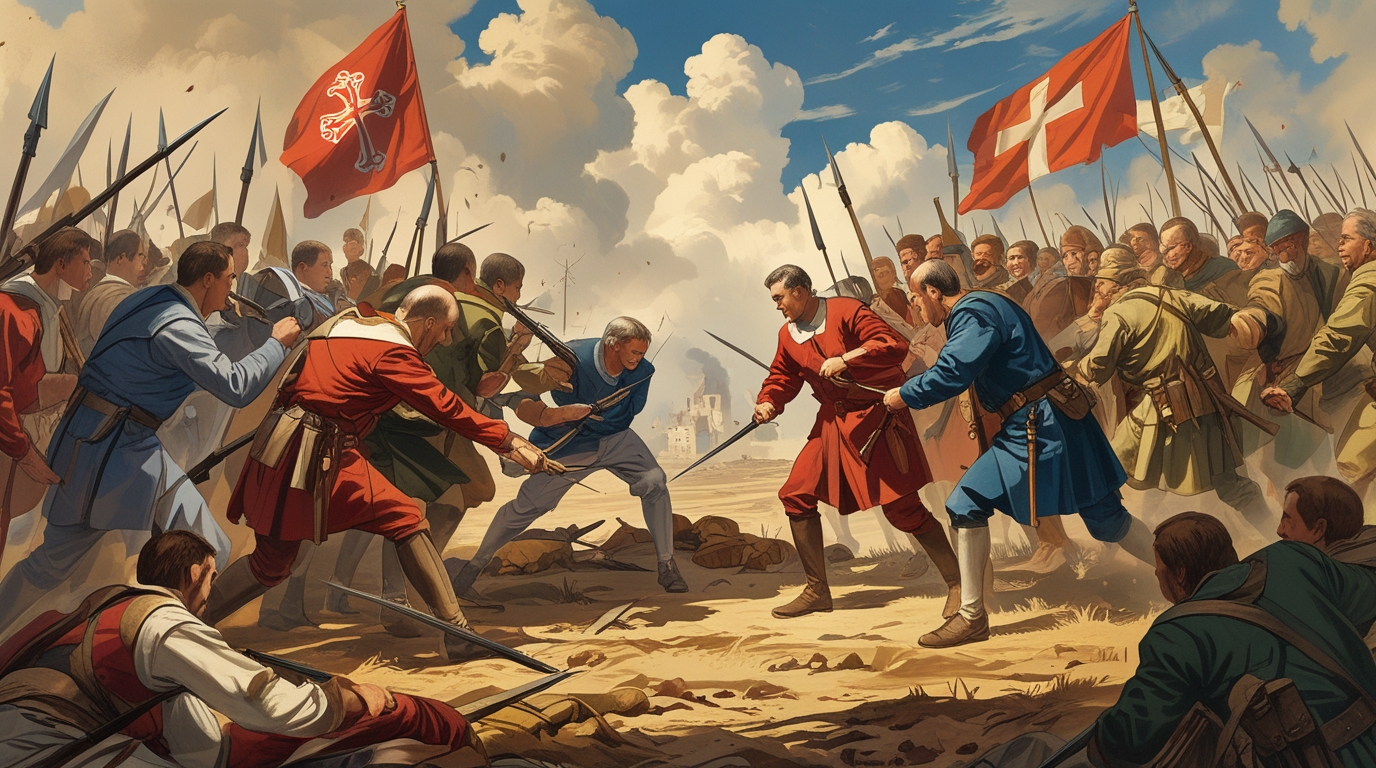
Millions suffered and died because they thought God was on their side.
Throughout human history, religion has often served as a source of comfort, meaning, and moral guidance. Yet, paradoxically, it has also been the cause—or the pretense—for some of the bloodiest and most prolonged conflicts on Earth. While few faith traditions begin with the intention of fostering violence, the intertwining of political power, human ego, and exclusive dogma has repeatedly transformed spiritual movements into instruments of war. State religions generally lead to unfortunate outcomes.
At One Holy Source, we believe in exploring the fullness of human spirituality—not only its highest aspirations, but also the moments when it has fallen into shadow. Below is a list of significant religious wars and conflicts that remind us why transcending divisive belief systems is essential for global peace.
A series of military campaigns was launched by European Christians against Muslims in the Holy Land. Spanning two centuries, these wars left millions dead and deeply scarred Christian-Muslim relations. While promoted as divine missions, they were often entangled with politics, greed, and territorial ambition. The sack of Constantinople in 1204 during the Fourth Crusade by Christians against Christians is particularly notable.
2. The Thirty Years’ War (1618–1648)
One of the deadliest wars in European history, this conflict began as a religious struggle between Catholics and Protestants in the Holy Roman Empire. It eventually escalated into a broader political war involving most European powers, resulting in over 8 million deaths and widespread devastation.
3. The French Wars of Religion (1562–1598)
Catholics and Huguenots (French Protestants) waged civil war in France for nearly four decades. The conflict culminated in the infamous St. Bartholomew’s Day Massacre, where thousands of Protestants were slaughtered in a single night.
Spanning nearly 800 years, this was a Christian campaign aimed at reclaiming the Iberian Peninsula from Muslim rule. It ended with the fall of Granada and the expulsion of Muslims and Jews from Spain. Religion and nationalism merged to forge a legacy of forced conversions and inquisitions.
5. The Islamic Jihad Conquests (7th–9th centuries)
After the death of the Prophet Muhammad, early Islamic caliphates expanded rapidly through military conquest across the Middle East, North Africa, and parts of Europe and Asia. While partly political, these expansions were framed as religious duty and brought widespread cultural shifts and conversions.
Fought between the Sikh Empire and the British East India Company, these wars were not purely religious but were fueled by cultural and spiritual differences. British fears about Sikh religious militancy influenced the harsh terms imposed after their defeat.
7. The Taiping Rebellion (1850–1864)
Led by a self-proclaimed messianic figure who believed he was the brother of Jesus Christ, this civil war in China combined elements of Christianity with Chinese mysticism. It resulted in 20–30 million deaths—making it one of the deadliest conflicts in history.
8. The Troubles in Northern Ireland (1960s–1998)
Though more political than purely religious, this conflict between Protestant Unionists and Catholic Nationalists was deeply colored by sectarian identities. Churches and religious symbols were used to mark territory, and faith affiliation became a proxy for political allegiance.
9. The Bosnian War (1992–1995)
In the wake of Yugoslavia’s breakup, ethnic and religious identities exploded into violence. Bosnian Muslims, Orthodox Serbs, and Catholic Croats engaged in brutal warfare, with religion again manipulated to fuel ancient resentments and justify mass atrocities.
10. The Hindu-Muslim Riots in India (Various, ongoing)
Since the partition of British India in 1947, ongoing violence between Hindus and Muslims has flared across the subcontinent. Though the roots often lie in political manipulation and socioeconomic inequality, religion is frequently used as the justification.
11. The Israeli-Palestinian Conflict (20th century–present)
At its core, a conflict over land and sovereignty, this enduring struggle has deep religious overtones. Sacred sites, competing historical narratives, and theological claims continue to fuel tension between Jews, Muslims, and Christians in the region.
12. The Yazidi Genocide by ISIS (2014–2017)
ISIS, a radical Islamic group, declared the Yazidis—a peaceful religious minority with pre-Islamic beliefs—heretics and launched a genocidal campaign against them. Thousands were killed or enslaved in one of the most horrific modern examples of religious extremism.
13. The Cathar–Roman Catholic Conflict: A Spiritual Schism Turned Religious War
The conflict between the Cathars and the Roman Catholic Church stands as one of medieval Europe’s most profound examples of how theological disagreement escalated into organized religious warfare. Unlike conflicts driven primarily by territorial ambition, the Cathar struggle was rooted in competing metaphysical worldviews, divergent interpretations of Christ’s teachings, and the institutional Church’s insistence on doctrinal uniformity.
Who Were the Cathars?
The Cathars—also known as Albigensians after the town of Albi in southern France—were a Christian dualist movement that flourished in the 12th and early 13th centuries, particularly in the region of Languedoc.
Cathar theology held that:
- Two fundamental principles governed existence: a good, spiritual God and an evil, material one
- The material world was corrupt, including the human body
- Christ was a purely spiritual being, not incarnate in flesh
- Salvation came through gnosis (direct spiritual knowledge), not sacraments
- The Roman Catholic Church was corrupted by wealth, power, and materialism
Cathars rejected the sacraments, Church hierarchy, and clerical authority. Instead, they emphasized personal spiritual purity, simplicity, and ethical living. Their spiritual leaders, known as Perfecti, lived ascetic lives and were widely admired for their moral rigor—often in stark contrast to the local Catholic clergy.
Why the Catholic Church Saw Catharism as a Threat
To the medieval Catholic Church, Catharism was not merely heretical—it was existentially dangerous.
Cathar teachings undermined:
- The authority of the Pope and the bishops
- The sacramental system, especially baptism and the Eucharist
- The Church’s claim as the sole mediator of salvation
- The legitimacy of Church wealth and feudal power structures
Moreover, Catharism gained broad popular support, including protection from regional nobility. Southern France operated with relative independence from northern French rule, compounding the Church’s anxiety. Heresy, political autonomy, and resistance to centralized authority had become deeply intertwined.
The Albigensian Crusade (1209–1229)
In 1208, following the murder of a papal legate, Pope Innocent III launched a crusade—not against Muslims or external enemies, but against fellow Christians.
The result was the Albigensian Crusade, one of the most brutal campaigns in European history.
Key features of the crusade included:
- Authorization for northern French nobles to seize lands in Languedoc
- Massacres of entire towns suspected of harboring heretics
- Indiscriminate killing of Catholics and Cathars alike
- Systematic destruction of the Cathar strongholds
The most infamous moment came during the sack of Béziers, where a papal commander reportedly said: “Kill them all; God will know His own.”
The war devastated southern France, dismantling its culture, political autonomy, and spiritual diversity.
Montségur and the Fall of the Cathars
The final symbolic blow came in 1244 at the fortress of Montségur, a mountaintop refuge for the last Cathar Perfecti.
After a prolonged siege:
- Over 200 Cathars were burned alive for refusing to renounce their faith
- Cathar's organized resistance effectively ended
- Survivors went underground or fled
While isolated believers persisted for decades, Catharism as a visible movement was destroyed.The Inquisition and Institutional Control
Following the crusade, the Catholic Church established the Medieval Inquisition to ensure heresy would never again spread so widely.
The Inquisition was introduced:
- Formalized interrogation and confession procedures
- Surveillance of belief, speech, and behavior
- Severe penalties for nonconformity
This marked a transition from ad hoc persecution to systematic religious policing, setting precedents that would echo throughout European history.
Why the Cathar Conflict Matters Today
The Cathar–Catholic conflict reveals a recurring pattern in religious history:
- Mystical or inner spirituality versus institutional authority
- Pluralism versus enforced orthodoxy
- Direct experience of the divine versus mediated control
- Spiritual truth becoming subordinate to political power
The Cathars posed a dangerous question: What if salvation did not require the Church at all?
The violent response answered that question decisively—but at great moral cost.
A Broader Lesson in Religious Wars
The Cathar conflict illustrates that religious wars are often less about God and more about control over meaning, authority, and access to truth. When spiritual experience threatens centralized systems, history shows that institutions frequently respond not with dialogue, but with force.
In this sense, the Cathars are not merely a medieval footnote. They are part of an enduring human struggle between inner knowing and external power, one that continues to surface wherever belief, identity, and authority collide.
A Shared Lesson Across Time
Each of these wars, whether overtly religious or politically motivated under a religious guise, reveals a sobering truth: when spirituality is corrupted by power, fear, and exclusion, it can lose its essence and become a weapon of division.
But it doesn't have to be that way.
At One Holy Source, we reject the idea that any one faith holds absolute truth. We celebrate the sacred spark within every tradition—and within every individual. The stories above do not indict religion itself, but call us to evolve past its tribal limitations.
True spirituality calls us inward, not outward, with swords drawn. It invites us to embody peace, not preach it with a clenched fist. And it challenges us to see through the illusions of separation that have caused so much suffering across centuries.
Toward a Peace Beyond Dogma
Let these tragic chapters in history be more than just lessons—they must become catalysts for awakening. The future of humanity depends not on what we believe, but on how we believe. With love, humility, and an open heart, we can transcend the ancient cycle of religious warfare.
Let us become students of unity.
Let us become living testaments to peace.
Let us endeavor to recognize that we are all creative extensions of One Holy Source and remain as created eternally.
________________________________________________________________________________________________________
Caring for the Body as Part of a Spiritual Practice
Many people want to get old without being old. They want the years, but not the consequences. They hope for wisdom without decline, vitality without restraint, and spiritual insight without the discipline required to maintain the body through which life is actually lived.
This hope is understandable. It is also unrealistic.
The human organism is not an accessory to the spiritual life. It is the medium through which perception, thought, and awareness occur. Every spiritual tradition ultimately operates through a biological system with limits, vulnerabilities, and predictable responses to neglect. To disregard those realities while claiming to pursue higher awareness is not transcendence—it is a kind of denial.
It is therefore not unusual to encounter individuals who sincerely believe they are on a spiritual path while maintaining habits that steadily degrade their health. Chronic overeating, poorly chosen diets, lack of metabolic discipline, and disregard for physical conditioning gradually diminish energy, clarity, and resilience. These patterns are often rationalized as irrelevant to spiritual development, as though consciousness could somehow flourish independently of the body that sustains it.
But the body keeps the ledger.
Over time, metabolic dysfunction, inflammation, and declining physiological resilience impose limits that cannot be bypassed by philosophy or belief. The organism responds to inputs—food, activity, rest, fasting—with remarkable consistency. When those inputs are careless, the results are equally predictable.
A more coherent view recognizes that caring for the body is not separate from a reflective life. It is part of it.
Food choices require awareness. Restraint around consumption requires discipline. Periods of fasting require patience and the ability to tolerate discomfort without immediate gratification. These are not merely health techniques. They are practices that mirror the same qualities cultivated in contemplative traditions: attention, restraint, and clarity about one's habits.
In this sense, health practices can function as a form of grounded spirituality—one that does not pretend the biological organism can be ignored while pursuing meaning or insight. Instead, it treats the body as the necessary foundation for sustained awareness and agency over the long arc of a lifetime.
For readers interested in exploring this perspective in practical, evidence-minded terms, Longevity Secrets examines how food choices, fasting patterns, and metabolic awareness can support a longer healthspan and a clearer relationship with the body that makes every human experience possible.

Longevity Is Cumulative
Healthspan reflects how well decisions were understood when they mattered.
A practical, evidence-minded book on fasting, nutrition, and aging—without hype or programs.

© Marcus Goodman LLC. All rights reserved