Here's a Nice Lotus Picture
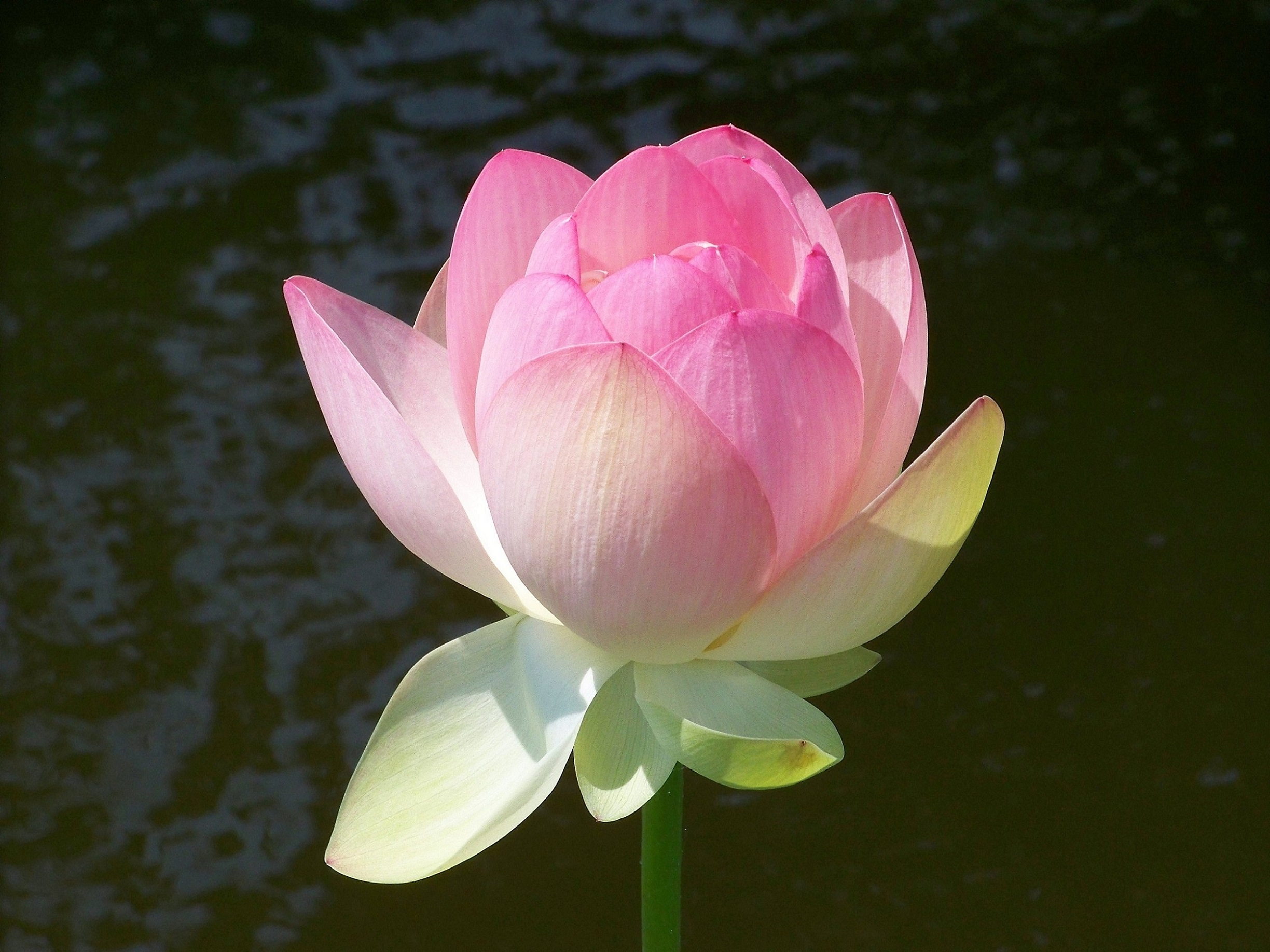
This lotus blossom picture, which is also seen on the bottom of this site, was taken by me on the afternoon of June 16, 2009.
It was a windy day. As you can see despite the wind, the picture came out very sharp and detailed. The wind driven ripples in the water make a nice background don't they?
I grew the plant myself from a chunk of root resembling horseradish root. Growing a lotus is easy if you follow the directions. Interestingly it's considered best to start with a piece of root instead of getting a plant.
Also the time of year is important. Vendors typically don't sell root stock after late winter or early spring.
I recommend growing it in a large container away from the main pond. The plant which produced the flower above developed a severe fungal infection soon after blooming. This could not be easily treated without poisoning the fish and frogs inhabiting the pond.
I also built the pond it grew in. It was the largest pond I ever built, fifty feet across at the widest, and about 4 feet deep on average. Building a garden pond is easy.
Go Ahead and Download the Image
That above image is a much larger file than the one at the bottom of this site. It's just under one megabyte. You can download the picture and do as you wish with it. Having it professionally printed and framed is a great idea. I did that and it turned out well.
Lotus Blossoms are Believed to Be Spiritually Significant by Many People Around this World
According to some believers, lotus blossoms are thought to symbolize spiritual transformation, as in rising up from the muck and mire of ego-mind domination to the unfolding beauty of spiritual awakening and God-Self recognition.
If you have ever done any digging in swampy soil or perhaps drained and cleaned out an aquarium that has been set up for a long time, you know about muck and mire. It stinks.
The sacred beliefs accorded to the lotus go back at least to ancient India and ancient Egypt. Today the flower is believed sacred by both Hindus and Buddhists. It is also the official flower of India and Vietnam.
Using the image of this sacred flower in your spiritual practice would provide you with a powerful symbol. There is a tremendous amount of collective belief associated with it going back many thousands of years.
There is already plenty of good information out there about the beliefs of people who have associated spiritual energy with this magnificent flower. I'll not get into it here.
________________________________________________________________________________________________________
Caring for the Body as Part of a Spiritual Practice
Many people want to get old without being old. They want the years, but not the consequences. They hope for wisdom without decline, vitality without restraint, and spiritual insight without the discipline required to maintain the body through which life is actually lived.
This hope is understandable. It is also unrealistic.
The human organism is not an accessory to the spiritual life. It is the medium through which perception, thought, and awareness occur. Every spiritual tradition ultimately operates through a biological system with limits, vulnerabilities, and predictable responses to neglect. To disregard those realities while claiming to pursue higher awareness is not transcendence—it is a kind of denial.
It is therefore not unusual to encounter individuals who sincerely believe they are on a spiritual path while maintaining habits that steadily degrade their health. Chronic overeating, poorly chosen diets, lack of metabolic discipline, and disregard for physical conditioning gradually diminish energy, clarity, and resilience. These patterns are often rationalized as irrelevant to spiritual development, as though consciousness could somehow flourish independently of the body that sustains it.
But the body keeps the ledger.
Over time, metabolic dysfunction, inflammation, and declining physiological resilience impose limits that cannot be bypassed by philosophy or belief. The organism responds to inputs—food, activity, rest, fasting—with remarkable consistency. When those inputs are careless, the results are equally predictable.
A more coherent view recognizes that caring for the body is not separate from a reflective life. It is part of it.
Food choices require awareness. Restraint around consumption requires discipline. Periods of fasting require patience and the ability to tolerate discomfort without immediate gratification. These are not merely health techniques. They are practices that mirror the same qualities cultivated in contemplative traditions: attention, restraint, and clarity about one's habits.
In this sense, health practices can function as a form of grounded spirituality—one that does not pretend the biological organism can be ignored while pursuing meaning or insight. Instead, it treats the body as the necessary foundation for sustained awareness and agency over the long arc of a lifetime.
For readers interested in exploring this perspective in practical, evidence-minded terms, Longevity Secrets examines how food choices, fasting patterns, and metabolic awareness can support a longer healthspan and a clearer relationship with the body that makes every human experience possible.

Longevity Is Cumulative
Healthspan reflects how well decisions were understood when they mattered.
A practical, evidence-minded book on fasting, nutrition, and aging—without hype or programs.
© Marcus Goodman LLC. All rights reserved